
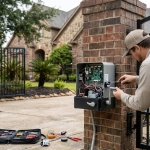

Most people only see an automatic gate from the outside. They press a button, and the gate either works or it doesn't. When it doesn't, the repair can feel like a black box: a technician arrives, pokes around, and leaves with a bill. Understanding what's actually happening in a good repair makes that process less mysterious and helps you judge whether the work is thorough. If you're researching an automatic gate repair service in League City, knowing the typical problems and the typical fixes is a good place to start.
This guide covers the most common automatic gate problems, what a professional actually does to fix each one, what you can safely check first, and how to tell when repair isn't the right answer.
How an Automatic Gate Works, in Brief
A residential or commercial automatic gate combines four systems:
|
System |
What It Includes |
Why It Matters |
|
Structure |
Gate panel, hinges or rollers, posts, track |
Carries the weight and sets alignment |
|
Drive |
Operator, motor, arms, chain, rack, or actuator |
Moves the gate |
|
Controls |
Control board, limit settings, access devices |
Decides when and how the gate moves |
|
Safety and power |
Sensors, loops, power supply, battery or solar |
Protects people and keeps the system alive |
Most failures start in one system but show up in another. A binding gate overheats the motor. A weak battery causes erratic board behavior. A dirty sensor stops everything. That's why professionals work across all four.
Problem 1: The Gate Won't Respond at All
What you notice: Nothing happens when you use the remote, keypad, or wall control, and the operator may have no lights.
Likely causes: Power loss, a tripped breaker or fuse, a failed power supply, a dead backup battery, or a board fault.
What a professional does:
- Confirms power at the source and at the operator
- Tests the power supply and, where applicable, batteries and charging
- Inspects connections for looseness and corrosion
- Tests the control board and protective components
- Repairs or replaces the failed component
- Tests the full operating cycle
The result: Power problems are often cheaper to fix than they feel, as long as they're found before parts are replaced by guess.
Problem 2: The Remote or Keypad Is Unreliable
What you notice: Remotes work only up close, keypads miss presses, or some devices work while others don't.
Likely causes: Weak batteries, lost programming, receiver trouble, water in an access device, or wiring faults.
What a professional does:
- Tests each device individually
- Replaces batteries and reprograms as needed
- Checks the receiver and its antenna
- Repairs or replaces weather-damaged keypads and readers
- Cleans up wiring and connections
The result: Dependable access for everyone who needs it, with devices that are properly registered.
Problem 3: The Gate Stops Partway or Reverses
What you notice: The gate starts normally, then stops, reverses, or won't close fully.
Likely causes: Dirty or misaligned sensors, drifting limit settings, mechanical binding, force settings that are too low, or an obstruction.
What a professional does:
- Cleans and aligns sensors, and tests wiring
- Tests obstruction detection and reversal
- Moves the gate by hand, with the operator disengaged, to check for binding
- Resets limits and force
- Replaces failed sensors if needed
The result: The gate completes its cycle while still protecting people and vehicles. A technician won't bypass a sensor to make the problem go away.
Problem 4: The Motor Runs but the Gate Barely Moves
What you notice: The operator hums, clicks, or grinds, but the gate doesn't move or moves only a little.
Likely causes: A disengaged or broken drive link, a worn gear, a stretched chain, a loose arm, or a gate that binds too much for the motor.
What a professional does:
- Disengages the operator and tests the gate by hand
- Inspects the arm, chain, rack, actuator, and mounting
- Repairs or replaces worn drive components
- Corrects any mechanical binding first
- Recalibrates limits and force
- Tests the operator under load
The result: A drive that moves the gate smoothly, rather than a motor fighting a problem it didn't create.
Problem 5: Slow, Jerky, or Noisy Operation
What you notice: The gate drags, shudders, or makes grinding, squealing, or rattling noises.
Likely causes: Worn rollers or hinges, dirty or damaged track, dry moving parts, a weak power supply, or motor wear.
What a professional does:
- Inspects hinges, rollers, track, and guide wheels
- Cleans and lubricates as appropriate
- Replaces worn wheels, bearings, or hinge components
- Straightens or repairs the track
- Tests the power supply
- Adjusts the drive
The result: Smoother travel and less strain on the motor, which can extend the operator's life.
Problem 6: A Sagging or Misaligned Gate
What you notice: The gate drags on the ground, rubs the post, or doesn't line up with the latch.
Likely causes: Worn hinges, leaning posts, frame fatigue, or ground settlement.
What a professional does:
- Supports the gate safely
- Inspects posts and footings
- Replaces or adjusts hinges
- Resets or reinforces posts as needed
- Re-squares and re-hangs the gate
- Re-sets the operator's limits to match the corrected position
The result: A gate that sits true, latches reliably, and no longer strains the operator.
Problem 7: Erratic or Self-Starting Behavior
What you notice: The gate opens or closes on its own, ignores commands, or behaves inconsistently.
Likely causes: A failing control board, loose wiring, moisture in the control box, interference, or an unstable power supply.
What a professional does:
- Reviews error indicators and recent events
- Inspects the control box for moisture, corrosion, or burn marks
- Checks connections and grounding
- Tests inputs and outputs
- Replaces the board or repairs wiring as needed
- Improves sealing or protection where appropriate
The result: Predictable behavior and a control box that's better protected from the next storm.
Problem 8: Failures After Storms or Outages
What you notice: The gate worked fine until a storm, then stopped.
Likely causes: Surge damage, moisture intrusion, a tripped breaker, depleted batteries, or debris.
What a professional does:
- Tests power, board, and supply for surge damage
- Dries and inspects affected enclosures
- Replaces damaged components
- Checks the batteries and charging system
- May recommend surge protection or better sealing
The result: A repair that addresses both the damage and the weakness that allowed it.
Problem 9: Rust and Environmental Wear
What you notice: Orange staining, flaking paint, stiff hinges, or seized wheels.
Likely causes: Humidity, moisture, and age.
What a professional does:
- Cleans and treats surface rust
- Replaces corroded hardware
- Reinforces or re-welds weakened sections
- Recommends protective coatings or more suitable materials
The result: A gate that's better equipped for local conditions.
What You Can Safely Check Before Calling
A few steps are reasonable for most owners:
- Replace remote and keypad batteries
- Check the breaker or power sBlockedword/sentence, without opening any housing
- Look at the operator's indicator lights and note the pattern
- Clean sensor lenses and check alignment
- Clear debris from tracks and the gate's path
- Try the manual release, only as the manufacturer directs
- Write down what happened and when
Avoid opening the operator, bypassing sensors, or forcing the gate.
How Professionals Avoid Wasting Your Money
A good technician follows a few habits that protect you:
- Diagnosing before replacing: testing power, controls, safety devices, and mechanics before suggesting parts
- Fixing mechanics first: because a binding gate can make a healthy motor look bad
- Explaining findings: showing what failed and why
- Providing written estimates: so there are no surprises
- Testing safety systems: every time
- Documenting the work: so you have a record
Repair or Replace?
Honest providers discuss both.
Repair is often reasonable when:
- The fault is isolated
- The operator and gate are otherwise reliable
- Parts are available
Replacement is worth considering when:
- The operator is old or underpowered, and parts are hard to find
- Repairs are frequent and expensive
- Safety features are outdated
- The gate's use has changed
If you're weighing a new system, it's reasonable to ask a provider about gate installation services as well, so you can compare the long-term cost of repair against a setup better suited to your property.
Choosing a Provider
Because automatic gates combine mechanical, electrical, and safety systems, look for a provider who diagnoses before replacing. Useful questions include:
- Are you licensed and insured?
- Do you work on my operator brand and gate type?
- How do you diagnose problems, and will you explain what you find?
- Is your estimate written and itemized?
- What warranty covers parts and labor?
A local company such as Level Up Garage Door Pros is an example of the kind of provider League City property owners can compare. If you want to see how a focused provider describes its approach, reading about an Automatic Gate Repair Service can help you judge whether their process matches the diagnosis-first approach described above.
Preventing Repeat Problems
- Lubricate and inspect moving parts as recommended
- Keep sensors clean and trimmed free of vegetation
- Test batteries on remotes, keypads, and backup systems
- Protect electronics from moisture and surges where possible
- Fix mechanical issues early, since binding strains the operator
- Test safety reversal periodically
- Schedule an annual professional inspection
Frequently Asked Questions
Why does a technician check the gate by hand? Moving the gate with the operator disengaged shows whether the problem is mechanical. If the gate binds, the motor isn't the real issue.
Can an automatic gate be repaired without replacing the operator? Often yes. Many problems involve sensors, power, hinges, or drive parts rather than the operator itself.
Why does my gate fail after storms? Surges and moisture are common culprits. A technician can test for damage and suggest protection.
Is it okay to bypass a sensor? No. Sensors protect people and property, and bypassing them is unsafe.
How long does a typical repair take? It depends on the problem and parts availability. A methodical technician can often diagnose and fix common issues in one visit.
Should I keep a spare remote or battery? Having fresh batteries and an extra programmed remote is a cheap way to avoid an unnecessary service call.
Final Thoughts
Automatic gate problems usually fall into a handful of familiar categories, and good repairs follow a predictable logic: test power, check controls and safety devices, fix the mechanics, then address the drive and board. Knowing what a thorough fix looks like helps you ask better questions and recognize quality work. Pair that with regular maintenance, and your gate is far more likely to stay reliable, safe, and ready whenever you need it.