
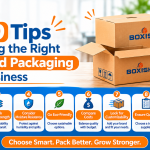

Choosing the right packaging is an important decision for businesses that store, ship, or distribute products. Packaging needs to protect goods during handling and transportation while remaining practical for everyday operations. The wrong packaging size or construction can increase product movement, material waste, and the risk of damage.
A suitable cardboard box can provide a protective outer structure for products while supporting organized storage, efficient packing, and reliable delivery. However, not every box is suitable for every product. Businesses need to consider product weight, dimensions, fragility, board construction, shipping distance, and storage conditions before making a purchase.
For ecommerce sellers, retailers, manufacturers, wholesalers, and distributors, selecting the right corrugated packaging can improve product handling and help manage packaging costs.
Here are ten practical tips to help your business choose suitable corrugated packaging.
1. Understand Your Product Requirements
Start by identifying what you need to pack. The product should determine the packaging specification rather than choosing a box simply because it looks strong or is readily available.
Before selecting a box, record:
-
Product length
-
Product width
-
Product height
-
Product weight
-
Product shape
-
Fragility
-
Surface sensitivity
-
Number of products per package
For example, clothing may require relatively simple packaging, while glassware and electronics may need additional cushioning and internal support.
Businesses packing multiple products together should also consider their combined weight and the possibility of direct contact between individual items.
Understanding these details makes it easier to select a suitable cardboard box for each product category.
2. Select the Correct Box Size
Box dimensions have a direct impact on product safety and packaging efficiency.
A box that is too large can leave excessive empty space, allowing the product to move during transportation. It may also require additional filler material.
An undersized box can put pressure on the product and make closing difficult.
Avoid Oversized Packaging
Large empty spaces can increase product movement, material consumption, and packing requirements.
Avoid Undersized Packaging
A tight fit may damage the product or leave insufficient space for cushioning.
Choose a Practical Fit
The ideal box should provide enough room for the product and necessary internal protection without unnecessary empty space.
Always check whether the supplier provides internal or external dimensions before ordering.
3. Choose the Appropriate Ply Construction
The number of layers is an important consideration when selecting corrugated packaging.
Two common constructions are 3-ply and 5-ply.
3-Ply Corrugated Boxes
3-ply construction generally consists of two flat liner layers and one fluted layer.
It can be suitable for many lightweight and moderately weighted products, including:
-
Clothing
-
Books
-
Stationery
-
Accessories
-
Small retail products
-
Lightweight ecommerce orders
5-Ply Corrugated Boxes
5-ply construction generally consists of three flat liner layers and two fluted layers.
It can provide greater rigidity and structural support, depending on the paper specifications and manufacturing quality.
It may be considered for:
-
Heavy products
-
Larger packages
-
Higher stacking requirements
-
Industrial components
-
More demanding transportation conditions
The choice should depend on product weight, dimensions, stacking, and shipping requirements. More layers are not automatically necessary for every application.
4. Consider Product Weight and Box Strength
Product weight plays an important role in determining the required packaging construction.
A box designed for lightweight products may not be appropriate for heavier shipments.
Businesses should consider the maximum expected packed weight, including:
-
Product weight
-
Internal protective materials
-
Dividers
-
Inserts
-
Additional contents
For multiple-product orders, evaluate the combined weight rather than the weight of individual items.
Also consider how the package will be lifted, stacked, loaded, unloaded, and transported.
A cardboard box should be selected according to the complete handling environment, not just the product's weight.
5. Evaluate Paper Quality, GSM, and Flute Construction
Businesses should not judge corrugated packaging only by its thickness or appearance.
Several specifications influence the performance of the finished box.
Paper Quality
The properties of the paper used in the board contribute to its structural performance.
GSM
GSM means grams per square metre and indicates paper weight. It is useful when comparing paper specifications, but it should not be treated as the only measure of finished box strength.
Flute Construction
The fluted layer contributes to rigidity, cushioning, and compression resistance.
Adhesive Quality
Proper bonding between paper layers helps maintain the board's structural integrity.
Manufacturing Consistency
Accurate dimensions, secure joints, and consistent construction can influence how reliably a box performs.
Ask your supplier about these specifications before placing a bulk order. Evaluate the complete board construction rather than relying on a single measurement.
6. Consider Shipping and Transportation Conditions
The packaging requirement can change depending on where and how the product will be transported.
A local delivery may involve fewer handling stages than a shipment travelling across several cities.
Consider whether packages will experience:
-
Long-distance transportation
-
Repeated loading and unloading
-
Courier handling
-
Vibration
-
Stacking pressure
-
Multiple sorting points
-
Storage before dispatch
A typical ecommerce shipment may move through:
Warehouse → Pickup → Sorting Centre → Distribution Hub → Delivery Vehicle → Customer
Each stage can expose the package to movement and handling.
Businesses should select corrugated packaging according to the complete delivery journey rather than only the final destination.
7. Plan Internal Protection for Fragile Products
The outer box is only one part of a complete packaging solution.
Fragile products may need additional materials to reduce movement and prevent direct contact.
Depending on the product, businesses can use:
-
Paper cushioning
-
Corrugated inserts
-
Dividers
-
Protective wrapping
-
Bubble cushioning
-
Molded inserts
For example, multiple glass products packed together may require dividers to prevent direct contact.
Electronics may need cushioning around sensitive components, while products with delicate surfaces may require protective wrapping.
The objective is to keep the contents stable without applying unnecessary pressure.
Use Corrugated Sheets for Additional Separation
A corrugated sheet can be used alongside the main box when products need additional separation or protective layers.
It may be useful for:
-
Separating multiple products
-
Creating internal dividers
-
Protecting flat surfaces
-
Placing layers between stacked items
-
Reducing direct product contact
For example, a business shipping several products in one carton can use corrugated sheets to separate individual items.
The appropriate sheet specification depends on the product and intended application.
8. Use Flexible Protection for Irregularly Shaped Products
Not every product has a convenient shape for standard packaging.
Furniture components, machinery parts, glass products, and products with exposed edges may require additional surface or corner protection.
A corrugated roll can provide flexible coverage because it can be cut according to the required length.
It may be useful for:
-
Irregularly shaped products
-
Furniture components
-
Machinery parts
-
Glass products
-
Product edges and corners
-
Sensitive surfaces
Businesses can wrap suitable items with corrugated rolls before placing them inside the main cardboard box.
For highly fragile or valuable products, specialized cushioning or inserts may still be necessary.
9. Consider Storage, Order Quantity, and Overall Cost
Selecting suitable packaging also involves planning how many boxes your business needs and where they will be stored.
Buying too few boxes can cause shortages, while purchasing excessive quantities can occupy valuable warehouse space and tie up working capital.
Before ordering, consider:
-
Average monthly packaging usage
-
Seasonal demand
-
Existing inventory
-
Available storage space
-
Supplier lead time
-
Minimum order quantity
-
Expected business growth
A simple calculation can help estimate your requirements:
Average monthly usage × planned stock period = estimated requirement
For example, a business using 1,000 boxes per month and maintaining two months of stock would need approximately 2,000 boxes, subject to seasonal demand and existing inventory.
Compare the Total Packaging Cost
Do not compare suppliers based only on the price per box.
Consider:
-
Box purchase price
-
Printing charges
-
Delivery costs
-
Storage requirements
-
Internal protective materials
-
Packing labour
-
Material wastage
-
Product damage
-
Replacement shipments
A correctly sized box may cost slightly more per unit but reduce filler usage and packaging-related problems.
10. Choose a Reliable Supplier and Test Samples
Supplier selection is important for businesses that purchase packaging regularly.
A suitable supplier should be able to explain product specifications and support your packaging requirements.
Before choosing a supplier, evaluate:
Product Range
Check whether the supplier offers the sizes and constructions your business needs.
Customization
Confirm whether custom dimensions and printing are available if required.
Quality Consistency
Repeat orders should maintain reasonably consistent dimensions and construction.
Bulk Order Capability
Check minimum order quantities and the supplier's ability to support your expected consumption.
Delivery Timelines
Understand production and delivery lead times before confirming an order.
Communication
Clear communication can help resolve specification questions and make repeat purchases easier.
Test Samples Before Bulk Purchasing
A product pBlockedword/sentenceograph cannot show how a box performs with an actual product.
Place your product inside the sample and check:
-
Product fit
-
Box assembly
-
Closing and sealing
-
Internal movement
-
Stacking
-
Handling
-
Internal protection
If possible, test the package under realistic storage and transportation conditions.
Sample testing can help identify problems before you commit to a large order.
Common Mistakes Businesses Should Avoid
Even when businesses purchase good-quality packaging, incorrect selection or use can reduce its effectiveness.
Some common mistakes include:
Choosing Only by Price
The lowest-priced box may not provide the required protection or product fit.
Using One Size for Every Product
Different products often require different dimensions and constructions.
Ignoring Product Weight
A box suitable for lightweight products may not perform well with heavier shipments.
Focusing Only on GSM
Paper weight is one specification and should be evaluated alongside ply, flute construction, dimensions, and manufacturing quality.
Leaving Excessive Empty Space
Too much empty space can increase product movement and filler requirements.
Forgetting Internal Protection
Fragile products may require cushioning even when the outer box is strong.
Ordering Without Testing
Businesses should test samples with actual products before placing large orders whenever possible.
Final Thoughts
Selecting the right corrugated packaging requires more than comparing box prices or choosing the thickest available construction. Businesses should evaluate product dimensions, weight, fragility, box size, ply, paper quality, transportation conditions, internal protection, storage, and supplier reliability.
A suitable cardboard box can help protect products during handling and transportation while supporting organized storage and efficient packing operations.
Businesses can also use a corrugated sheet for additional separation and a corrugated roll for flexible protection around suitable irregularly shaped products and sensitive surfaces.
By understanding product requirements, testing samples, selecting appropriate box constructions, and planning packaging inventory carefully, businesses can build a more reliable packaging system that supports everyday operations and reduces avoidable packaging-related problems.
Frequently Asked Questions
1. How do I choose the right cardboard box for my business?
Consider product dimensions, packed weight, fragility, shipping distance, stacking requirements, storage conditions, and the need for internal protection. Testing a sample with the actual product is also recommended.
2. Should I choose 3-ply or 5-ply corrugated packaging?
3-ply can be suitable for many lightweight and moderately weighted products, while 5-ply can be considered for heavier products, larger packages, higher stacking requirements, and more demanding transportation conditions.
3. Why is box size important when selecting corrugated packaging?
A box that is too large can allow excessive product movement, while an undersized box can put pressure on the contents. A properly sized box provides room for the product and required protective material without unnecessary empty space.
4. When should businesses use corrugated sheets and rolls?
Corrugated sheets can be used as dividers, separators, and protective layers inside packaging. Corrugated rolls can provide flexible wrapping for suitable irregularly shaped products, edges, corners, and sensitive surfaces.
5. What should businesses check before buying corrugated boxes in bulk?
Check product dimensions, packed weight, box construction, ply, paper specifications, shipping conditions, internal protection, storage capacity, supplier consistency, delivery timelines, and sample performance before placing a large order.