

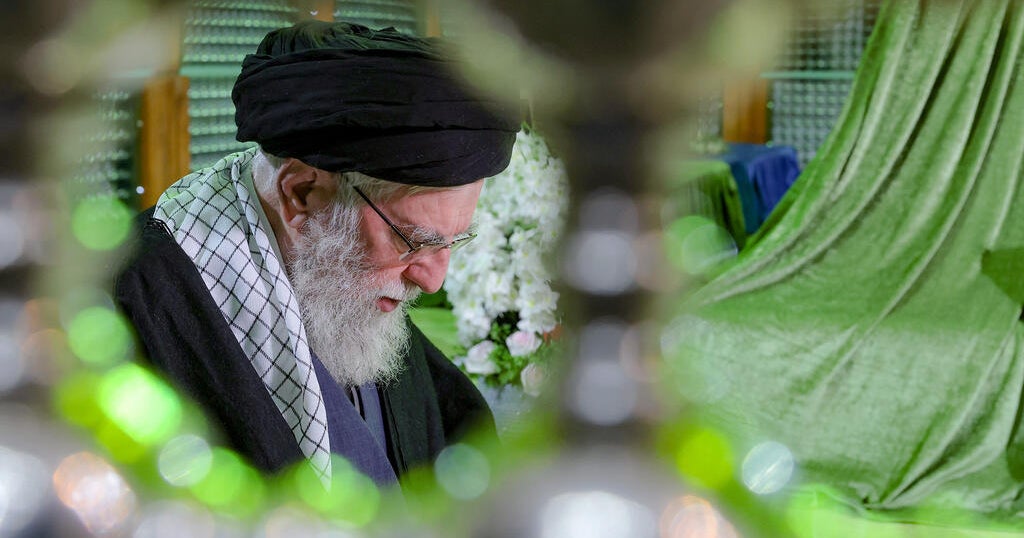
Iran's supreme leader warned that any attack on the country by the United States would spark a "regional war" in the Middle East, following President Trump's threats to intervene militarily in response to the Islamic Republic's crackdown on recent nationwide protests.
Ayatollah Ali Khamenei's comments, made while speaking to a crowd at his compound in Tehran and as quoted by the Tasnim news agency, are the most direct threat he's made so far since the USS Abraham Lincoln aircraft carrier group arrived in international waters off Iran, in the Persian Gulf.
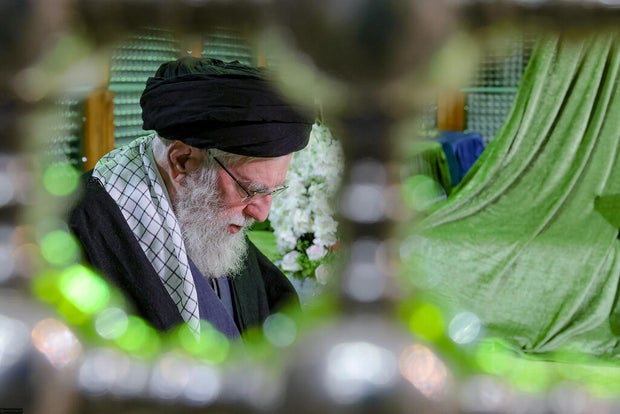 In this photo released by an official website of the office of the Iranian supreme leader, Supreme Leader Ayatollah Ali Khamenei prays at the grave of the late revolutionary founder Ayatollah Khomeini, just outside Tehran, Iran, Saturday, Jan. 31, 2026.
Office of the Iranian Supreme Leader via AP
In this photo released by an official website of the office of the Iranian supreme leader, Supreme Leader Ayatollah Ali Khamenei prays at the grave of the late revolutionary founder Ayatollah Khomeini, just outside Tehran, Iran, Saturday, Jan. 31, 2026.
Office of the Iranian Supreme Leader via AP
Mr. Trump has also mentioned his desire to curb Iran's nuclear program in his recent remarks, but it remains unclear whether Mr. Trump will use force. He has repeatedly said Iran wants to negotiate.
He had said he wanted to continue negotiations last year before then deciding to strike Iran's nuclear sites last June, supporting Israel's 12-day war with the country. On Saturday, Mr. Trump declined to say whether he'd made a decision on what he wanted to do regarding Iran now.
Speaking to reporters as he flew to Florida, Mr. Trump sidestepped a question about whether Tehran would be emboldened if the U.S. backed away from launching strikes on Iran, saying, "Some people think that. Some people don't."
He said Iran should negotiate a "satisfactory" deal to prevent the Middle Eastern country from getting any nuclear weapons, but said, "I don't know that they will. But they are talking to us. Seriously talking to us."
In Tehran, Khamenei claimed that the U.S. is interested in the country's oil, natural gas and other mineral resources. He said the Americans wanted to "seize this country, just as they controlled it before."
"The Americans must be aware that if they wage a war this time, it will be a regional war," he said.
The supreme leader added that: "We are not the instigators, we are not going to be unfair to anyone, we don't plan to attack any country. But if anyone shows greed and wants to attack or harass, the Iranian nation will deal a heavy blow to them."
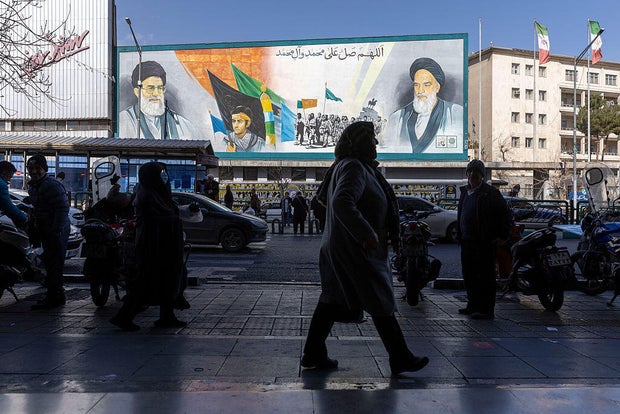 Iranians walk along a sidewalk on Enqelab-e-Eslami (Islamic Revolution) Street in downtown Tehran, Iran with a mural of Ayatollah Khamenei and Ayatollah Khomeini in the background on February 1, 2026.
Majid Saeedi / Getty Images
Iranians walk along a sidewalk on Enqelab-e-Eslami (Islamic Revolution) Street in downtown Tehran, Iran with a mural of Ayatollah Khamenei and Ayatollah Khomeini in the background on February 1, 2026.
Majid Saeedi / Getty Images
Khamenei also hardened his position on the recent demonstrations after earlier acknowledging some protesters had had legitimate economic grievances. The demonstrations began Dec. 28, initially over the collapse of Iran's rial currency. It soon grew into a direct challenge to Khamenei's rule.
"The recent sedition was similar to a coup," he said. "Of course, the coup was suppressed. Their goal was to destroy sensitive and effective centers involved in running the country, and for this reason they attacked the police, government centers, (Revolutionary Guard) facilities, banks and mosques — and burned copies of the Quran. They targeted centers that run the country."
The U.S.-based Human Rights Activists News Agency, which relies on a network of sources inside Iran to gather its information, says it has verified the deaths of 6,713 people, most of them demonstrators, and that the authorities have detained at least 49,500 people so far. The Associated Press has been unable to independently assess the death toll and arrest figures, given that authorities have cut Iran's internet off from the rest of the world. Other sources have told CBS News and other media that the actual death toll across the country is substantially higher.
As of Jan. 21, Iran's government put the death toll at a far lower 3,117, saying 2,427 were civilians and security forces, labeling the rest "terrorists." In the past, Iran's theocracy has undercounted or not reported fatalities from unrest.
Even this government figure exceeds the death toll reported from any other round of protest or unrest in Iran in decades and recalls the chaos surrounding the 1979 revolution.
Iran has planned a live-fire military drill for Sunday and Monday in the strategic Strait of Hormuz, the narrow mouth of the Persian Gulf through which a fifth of all oil traded passes. The U.S. military's Central Command, which is the Pentagon's regional combatant command for the Middle East, has warned against threatening American warships or aircraft during the drill or disrupting commercial traffic.
The Standoff with Iran More Satellite photos show activity at Iran nuclear sites as protest tensions rise Iranians are anxious, but some hope Trump will "fulfill his promise"
 As Trump pressures Iran with "armada," Mideast allies urge him not to strike
 Trump warns Iran to make a nuclear deal, threatening new U.S. attack
 Would-be assassin of Iranian dissident sentenced to 15 years in prison

Go deeper with The Free Press
Niall Ferguson: What Happens Next in Iran Will Change the Middle East Forever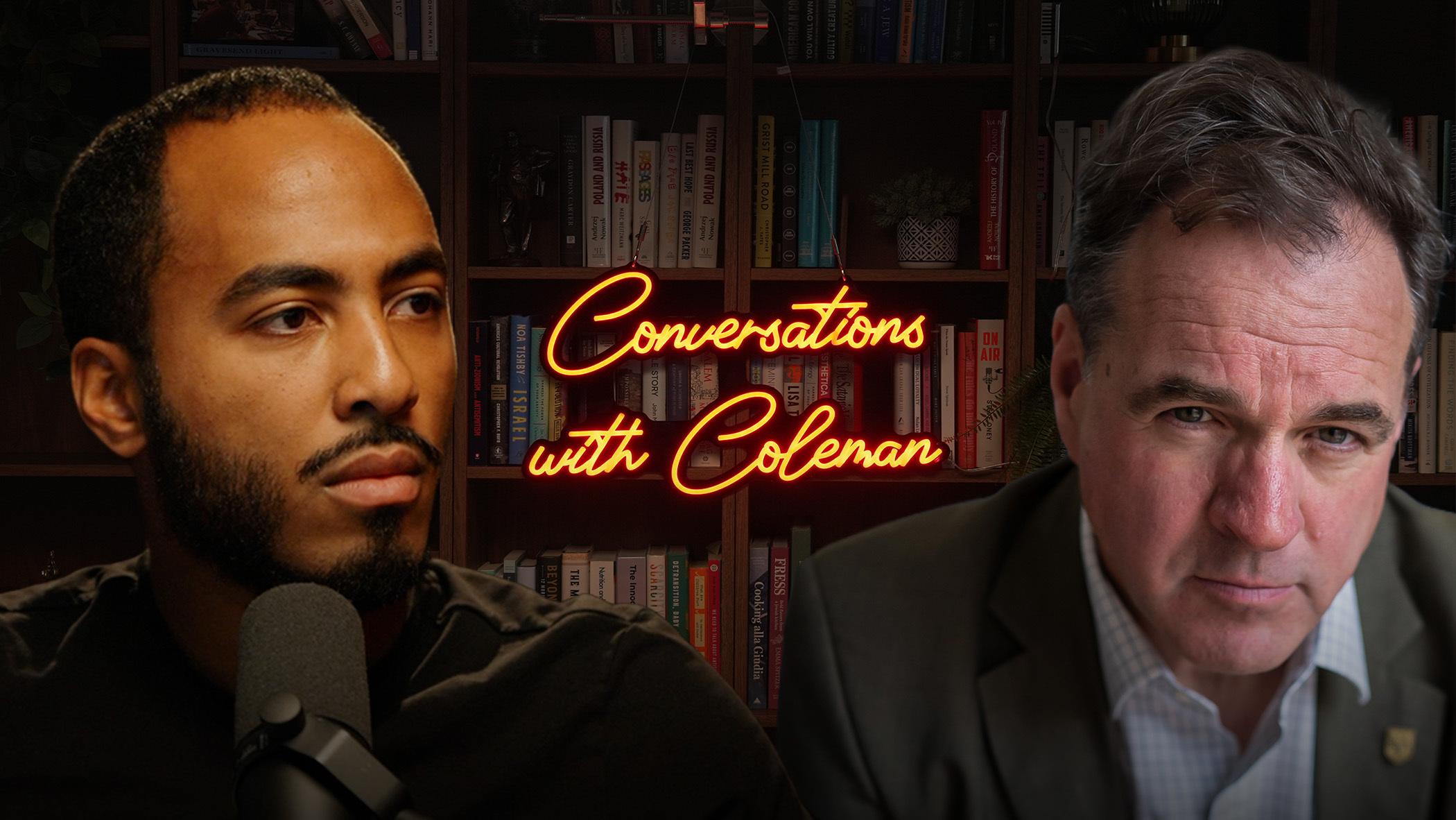 Would Trump Really Attack Iran Again?